Only 20% of the content on a website is being read on average
Various studies suggest, that The average user has an attention span of only around 8 seconds (compared to an average attention span of around 12 seconds in 2000).
Although this is difficult to measure, and other experts disagree with the methodologies in these studies the attention span and the average page view duration is certainly lower than what would be needed in order to read all of the words on a single page.
A study by the Nielsen Norman Group showed that on average only between 20% and 28% of the content on a page is read. Although pages with more words also had a longer pageview duration, users stayed only 4.4 seconds longer for every 100 additional words.
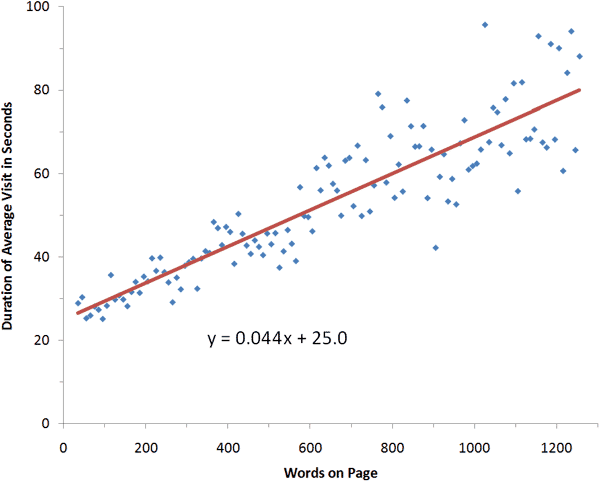
This suggests that in order to achieve an average of 50% read words, a page should not contain more than 111 words. The longer the content of a page becomes, the more the reading rate decreases. So there are certainly some Diminishing Returns at play, when writing longer content pieces.
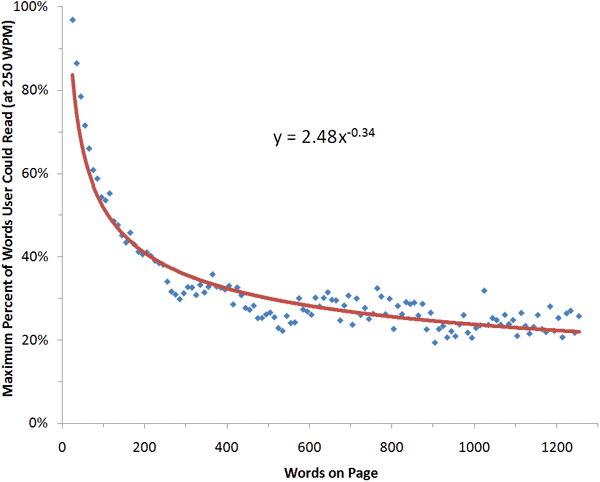
In the data set of the study, the average word count was 593 words per page. Thus, users read an average of only 28% of the content - assuming that they read exclusively the entire time. A more realistic estimate is that on average only 20% of the content is read.
Implications
- A large proportion of texts on web pages are not read (around 80 %). So a high investment of resources in long-form text content should be questioned. The data does not necessarily mean that a part of the content is read by absolutely no one, but the cost-benefit ratio is certainly negative for particularly long text content.
- Particularly long texts should always be accompanied by abbreviated versions (e.g. summaries of the most important information as bullet point lists). This is also a case of tl;dr.
- Content should be formulated in such a way that important content is included as far up as possible (above-the-fold).